Essays: Question 1: You are the Quality Manager of an ANO-145 organization that carries out Line Maintenance of Boeing B777 Aircrafts. What requirements will you check before issuing the Certification Authorization to the Aircraft Licensed Mechanic in Category B1.1. Question 2: An ANO-145 organization has a maintenance facility located outside Pakistan. What are the conditions under which the organization can use a certifying staff qualified in accordance with the national aviation regulations of the State in which the organisation facility is registered. Question 3: An aircraft is grounded at a location other than the main base where no appropriate certifying staff is available, how will the aircraft be released for service in this case. Also write additional requirements for the maintenance organization if any. Question 4: As per ANO-145 , what are different categories under which the aircrafts components must be segregated? Also explain how the unsalvageable i...
EASA MODULE 7A Sub Module 7.17 AIRCRAFT HANDLING AND STORAGE AIRCRAFT JACKING: Aircraft may need to be jacked for a variety of purposes. These may include component changes, retraction tests, weighing of the aircraft and aircraft rigging checks. Care needs to be taken when jacking, to avoid damage to aircraft or equipment. Jacking points are provided in the wings and fuselage, at strong points, to enable the whole aircraft to be lifted, and there are, usually, other points, at the nose and main undercarriages, to enable individual wheels to be changed. Some aircraft require a jacking pad to be fitted to each jacking point, while in some, the jacking pads are built into the structure. Special jacking adapters and beams may be available to lift individual axles. In all instances, the Maintenance Manual should be consulted, so that the correct equipment and procedures may be used. Because of the position of the jacking points, the C.G. of some aircr...
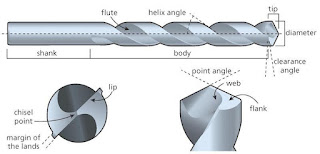
EASA PART 66 MODULE 7 MAINTENANCE PRACTICES SUB MODULE 7.3 Twist Drills: Twist drill is a cutting tool comprised of cutting point at tip of a shaft with helical cutting edge. While the range of tools, designed to create holes in metals and other materials is vast, the Morse-type (named after its inventor, an American engineer) of Twist Drill (refer to Fig. 3.13) is the one most commonly used in aircraft (and in general) engineering. The shank is the part of the twist drill that is gripped and driven by the chuck of the drilling machine and it is on the shank that the details of the type (grade) and diameter of the drill can usually be found printed or engraved. On drills up to 12.5 mm (½”) diameter, the shank is parallel and placed into the jaws of a self-centring chuck. On drills above 12.5 mm the shank is usually tapered (to a Morse Taper) of 1:20. The tapered shank fits directly into a matching tapered housing in the drilling machine spindle. The tapered shank usually ends in a tan...

Comments
Post a Comment